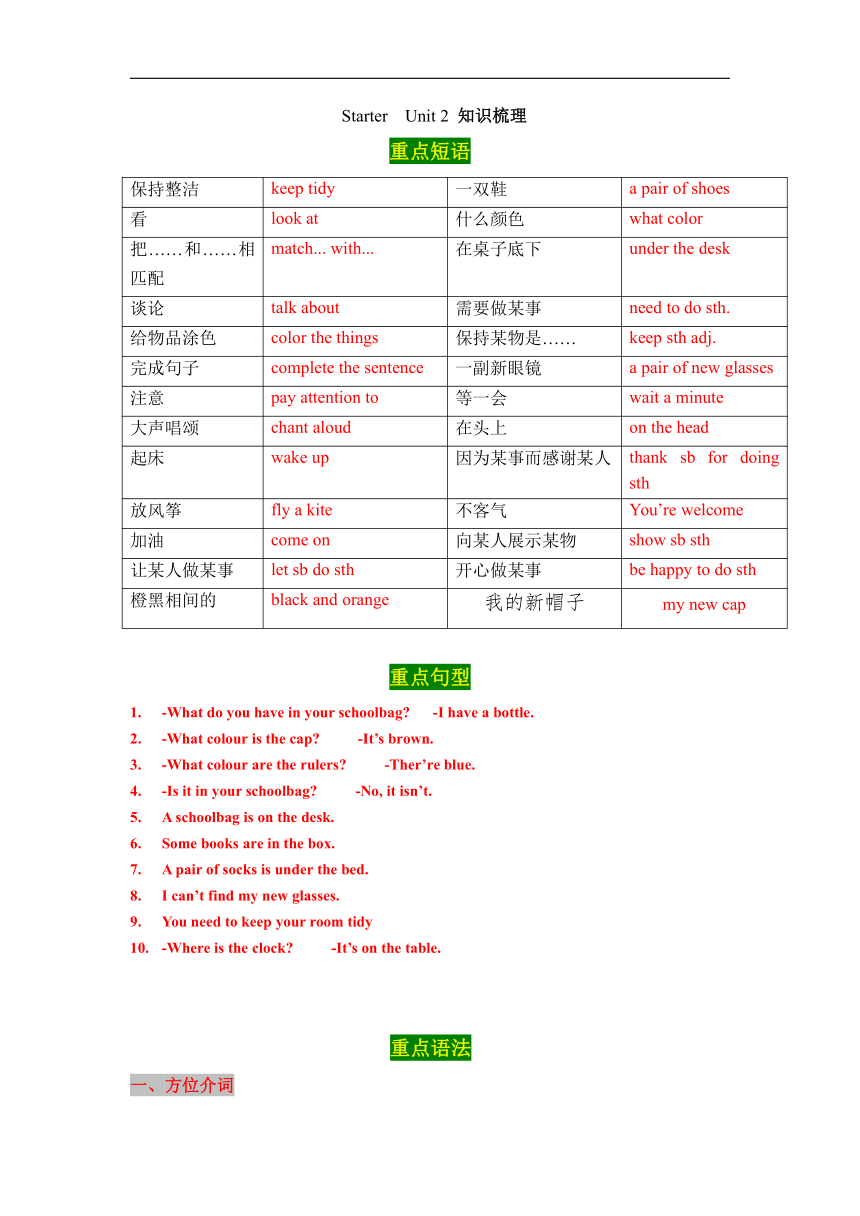
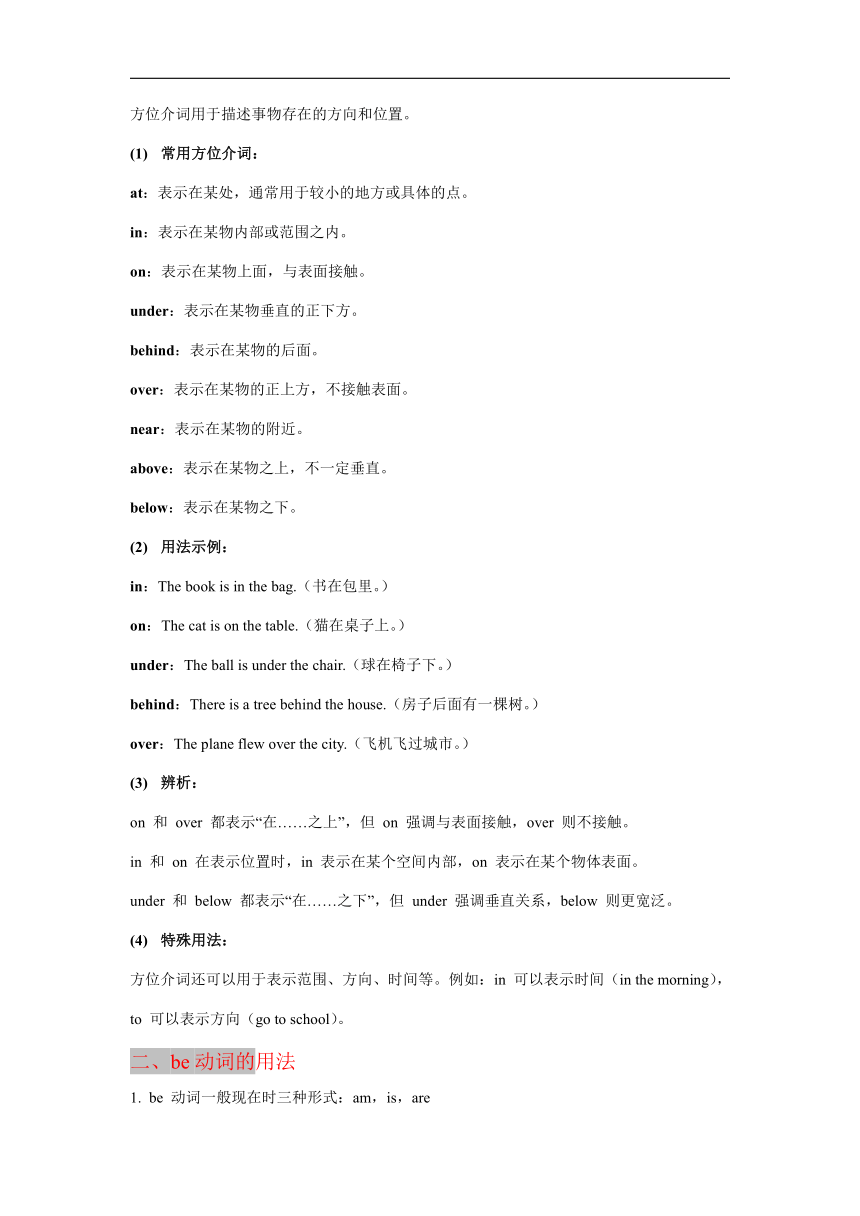
Starter Unit 2 知识梳理 重点短语 保持整洁 keep tidy 一双鞋 a pair of shoes 看 look at 什么颜色 what color 把……和……相匹配 match... with... 在桌子底下 under the desk 谈论 talk about 需要做某事 need to do sth. 给物品涂色 color the things 保持某物是…… keep sth adj. 完成句子 complete the sentence 一副新眼镜 a pair of new glasses 注意 pay attention to 等一会 wait a minute 大声唱颂 chant aloud 在头上 on the head 起床 wake up 因为某事而感谢某人 thank sb for doing sth 放风筝 fly a kite 不客气 You’re welcome 加油 come on 向某人展示某物 show sb sth 让某人做某事 let sb do sth 开心做某事 be happy to do sth 橙黑相间的 black and orange 我的新帽子 my new cap 重点句型 -What do you have in your schoolbag -I have a bottle. -What colour is the cap -It’s brown. -What colour are the rulers -Ther’re blue. -Is it in your schoolbag -No, it isn’t. A schoolbag is on the desk. Some books are in the box. A pair of socks is under the bed. I can’t find my new glasses. You need to keep your room tidy -Where is the clock -It’s on the table. 重点语法 一、方位介词 方位介词用于描述事物存在的方向和位置。 常用方位介词: at:表示在某处,通常用于较小的地方或具体的点。 in:表示在某物内部或范围之内。 on:表示在某物上面,与表面接触。 under:表示在某物垂直的正下方。 behind:表示在某物的后面。 over:表示在某物的正上方,不接触表面。 near:表示在某物的附近。 above:表示在某物之上,不一定垂直。 below:表示在某物之下。 用法示例: in:The book is in the bag.(书在包里。) on:The cat is on the table.(猫在桌子上。) under:The ball is under the chair.(球在椅子下。) behind:There is a tree behind the house.(房子后面有一棵树。) over:The plane flew over the city.(飞机飞过城市。) 辨析: on 和 over 都表示“在……之上”,但 on 强调与表面接触,over 则不接触。 in 和 on 在表示位置时,in 表示在某个空间内部,on 表示在某个物体表面。 under 和 below 都表示“在……之下”,但 under 强调垂直关系,below 则更宽泛。 特殊用法: 方位介词还可以用于表示范围、方向、时间等。例如:in 可以表示时间(in the morning),to 可以表示方向(go to school)。 二、be动词的用法 be 动词一般现在时三种形式:am,is,are be动词 用法 am I is he she it 单数名词 are you 复数名词 【口诀】 我(I)用am,你(you)用are,is 连着他(he),她(she),它(it),其余单数用is,复数用are. be动词的一般现在时 肯定式 否定式 疑问式 疑问式的回答 I am a teacher. 我是一位教师。 I am not a teacher. 我不是一位教师。 Am I a teacher? 我是一位教师吗? Yes, I am. 是的,我是。 No, I am(=I’m)not. 不,我不是。 He/She is a teacher. 他/她是一位教师。 He/She is not(=isn’t) a teacher. 他/她不是一位教师。 Is he/she a teacher? 他/她是一位教师吗? Yes,he/she is.是的,他/她是。 No,he/she isn’t. 不,他/她不是。 We/ You /They are teachers. 我们/你们/他们是教师。 We/ You /They are not(=aren’t) teachers. 我们/你们/他们不是教师。 Are we/you/they teachers? 我们/你们/他们是教师吗? Yes,we/you/they are. 是的,我们/你们/他们是。 No,we/you/they aren’t. 不,我们/你们/他们不是。 It is Marry. 它是Marry。 It is not(=isn’t) Marry. 它不是Marry。 Is it M ... ...
~~ 已预览到文档结尾了 ~~